
Author: Prof Siphamandla Zondi, Director: Institute for Pan-African Thought and Conversation, University of Johannesburg, South Africa.
Date: 03 August 2026
This is science month, an opportunity to reflect on the uses of science for all of us. Does science produced by scientists really belong to us all? It is financed by all of us, but is it for all of us? Scientists promise to work in the public interest, to help solve real challenges that we, the people, face, but do they? They trumpet their commitment to solutions and innovations that help society as a whole improve. But do they?
This blog reflects on these questions based on the outcomes of the 2022 South African Public Relationship with Science Survey (SAPRS) conducted by the Human Sciences Research Council (HSRC). This excellent piece of work makes the case for calibrating the relationship between science and society. Read its full details on the HSRC website.
Whatever the answers to the above question, what is certain is that every day we rely on science, often without even noticing it. From checking the weather before leaving home to receiving healthcare, using mobile phones, travelling safely, growing food, or accessing clean water, science quietly shapes our lives. Yet many people still see science as something that belongs in laboratories, universities, or research institutions rather than to everyone.
Key among findings from the survey are:
- South Africans generally have positive attitudes towards science, with 76% agreeing that science and technology make life healthier, easier and more comfortable.
- Interest in science is relatively high, with 66% expressing an interest in science and technology, although only 60% reported being aware of science and technology developments in South Africa.
- Trust in scientists is strong, with universities and research organisations emerging as the most trusted sources of scientific information.
- Environmental issues matter to the public, with water pollution, cleaner water supplies, energy security and education identified as the science-related issues of greatest concern and interest.
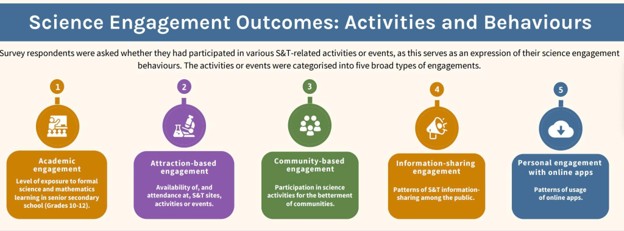
- Science engagement remains relatively low. More than half (55%) reported not attending any science-related events or activities, indicating significant room for growth in public participation.
- Digital access is widespread, with 94% owning a cellphone and 76% having internet access, making digital platforms important channels for science communication.
- Television and radio remain the most trusted channels for science information, while confidence in science information shared through social media is comparatively lower.
- Young people are seen as key to South Africa’s scientific future. Around 86% believe young people should be encouraged to learn science and technology, while 85% see digital skills as increasingly important.
- Education and family support strongly influence science engagement. Higher educational attainment and encouragement at home were consistently associated with better science knowledge, more positive attitudes and greater participation.
- The survey concludes that science engagement should become more inclusive, participatory and accessible, encouraging dialogue between scientists and communities while expanding opportunities for all South Africans to engage with science.
The findings of the Survey remind us that building a scientifically engaged society is not simply about teaching people more scientific facts. It is about building stronger relationships between science and society.
The survey’s recommendations point to an important truth: people want science that is relevant, understandable, accessible and connected to their everyday experiences.
The most encouraging recommendation is the call to create genuine conversations between scientists and communities. Too often, science communication has been treated as a one-way process in which experts explain, and the public listens. The survey suggests a different approach.
People want opportunities to ask questions, express concerns, challenge assumptions, and contribute to their own experiences. This reflects a growing understanding that trust in science is built through dialogue rather than lectures.
The survey also reminds us that science should not be reserved for classrooms or laboratories. It should become part of everyday life. Schools, community centres, radio stations, television programmes and social media all have an important role in showing how science influences health, farming, business, transport, energy, climate and even household decisions. When people recognise science in the issues they face daily, it becomes meaningful rather than abstract.
Another important message is the need to extend science opportunities to more communities. South Africa has many successful science centres, exhibitions and outreach programmes, but they often reach only a small proportion of the population. Rural communities, underserved schools and disadvantaged neighbourhoods deserve equal opportunities to experience science through exhibitions, practical demonstrations and community events. Curiosity should never depend on where someone lives.
The emphasis on nurturing curiosity from an early age is particularly significant. Children are naturally curious. They ask questions, explore their surroundings and enjoy discovering how things work. Families, teachers and communities should encourage rather than suppress this curiosity. Visiting science centres, participating in science festivals and conducting simple experiments at home can help young people develop confidence in asking questions and seeking evidence.
The survey also highlights something that extends beyond science itself: the importance of building a culture that values evidence. In an age of misinformation, conspiracy theories, and rapidly spreading social media content, the ability to evaluate information critically has become an essential life skill. Encouraging people to ask questions, debate respectfully and use evidence before making decisions benefits not only science but also democracy and public policy.
Equally important is the recognition that science communication must be inclusive. South Africa’s diversity is one of its greatest strengths. Communicating science in different languages, respecting cultural contexts, and acknowledging diverse life experiences make science more accessible and relevant. Inclusivity is not simply about translation; it is about ensuring that every South African feels that science speaks to their reality.
The recommendation to simplify science without oversimplifying it deserves particular attention. Scientific ideas can be communicated clearly without losing their accuracy. Community radio, television, newspapers, podcasts, and online platforms all provide opportunities to explain scientific developments in everyday language and with familiar examples. Good science communication does not make science less rigorous; it makes it more understandable.
Finally, the survey reminds us that awareness alone is not enough. People need opportunities to participate. Public campaigns, science festivals, open days at research institutions, citizen science projects and community-based innovation initiatives can all help transform passive audiences into active participants.
The more people engage with science, the more likely they are to trust it, support it and use it in their own lives. This is a huge challenge for science formations in their form to interface with communities, as much for engagement with the substance of their science as for collecting data during research.
The message emerging from this survey is both simple and powerful: science belongs to everyone. Building a scientifically engaged society is not only the responsibility of scientists. It is a shared responsibility involving schools, universities, government, the media, civil society, families and communities themselves.
As South Africa celebrates National Science Month, revisiting the survey’s outcomes offers an opportunity to reflect on the uses of science for the whole of society. It offers an opportunity to nurture a vision of a society where science is not distant or intimidating, but woven into everyday conversations, informed decision-making and community life.
Achieving this vision will require sustained investment, collaboration and creativity. But if we succeed, we will not simply have a population that knows more science—we will have a society that is better equipped to solve problems, seize opportunities and shape a more inclusive and innovative future together.
It is time to decolonise science by forcing it to make sense to ordinary people and enabling them to own its direction.